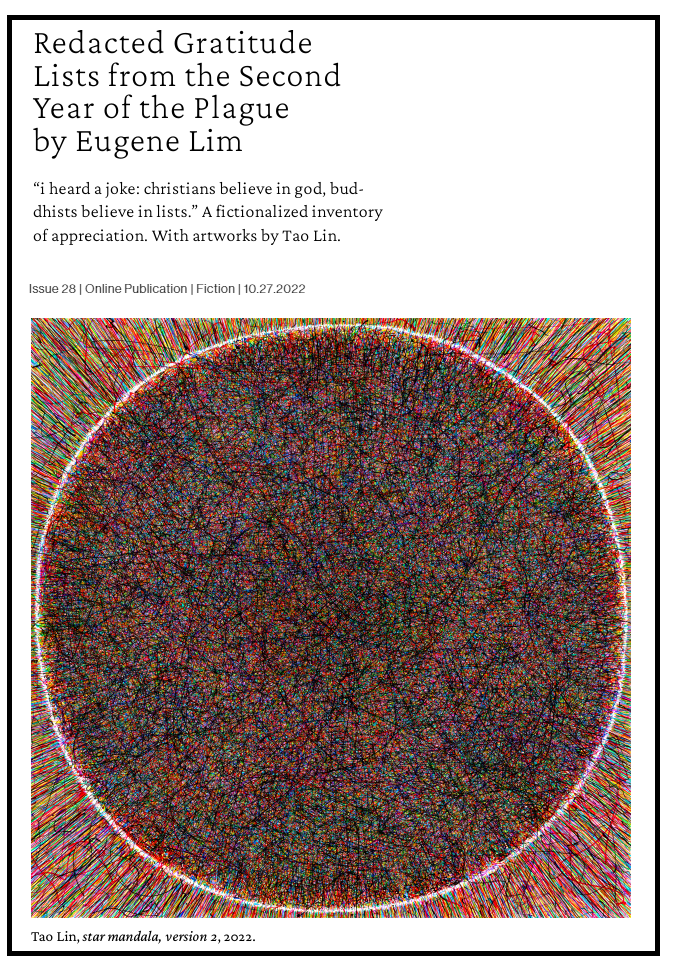
Triple Canopy’s latest issue (#28) is titled “True to Life,” and “considers how we narrate our lives, and how these narratives provide a sense of oneself in the world (and of the world itself).”
S, thru his AA practice and his secret shamanism, introduced me to the idea of gratitude lists… and I took it to create a kind of autofiction for the issue called “Redacted Gratitude Lists from the Second Year of the Plague.” It is illustrated by Tao Lin’s rather mesmerizing mandala artwork.
The Quote Real World is many things, including this short fiction recently published in the adventurous and excellent new journal 128 Lit and an excerpt from a novel-in-slow-(illusory)-progress.
As everyone knows, in America, one cannot be a novelist and make a living at it. There are various ways around this predicament, but all—except private wealth, suicide, or crime—require day jobs. Some choose to be critics (“eunuchs at the orgy”); most choose to be professors (teaching what?), and a few get the questionable privilege of becoming the script doctors, inspiration to, or simply brand of, a movie or stream show.
Me? At the time we’re talking about, I was still young, in my late twenties. I thought I was hot shit but was making a living (barely) as a part-time dog walker and take-out-food courier. I fancied myself a writer… ________________
The Artist is often asked how much he suffered to make the piece. He replied that he didn’t suffer. I have pleasure to do the piece. Some who have written about Time Clock Piece point out how exhausted the Artist looks. Yet when Alice looks closely at the Artist’s face — in the film, in the photo stills — she doesn’t see it. What she sees is the will of a man stitching himself into time. Only after the piece was completed was the Artist disconsolate. He felt that way after all his pieces ended, he said, because it meant returning to the life of an ordinary man.
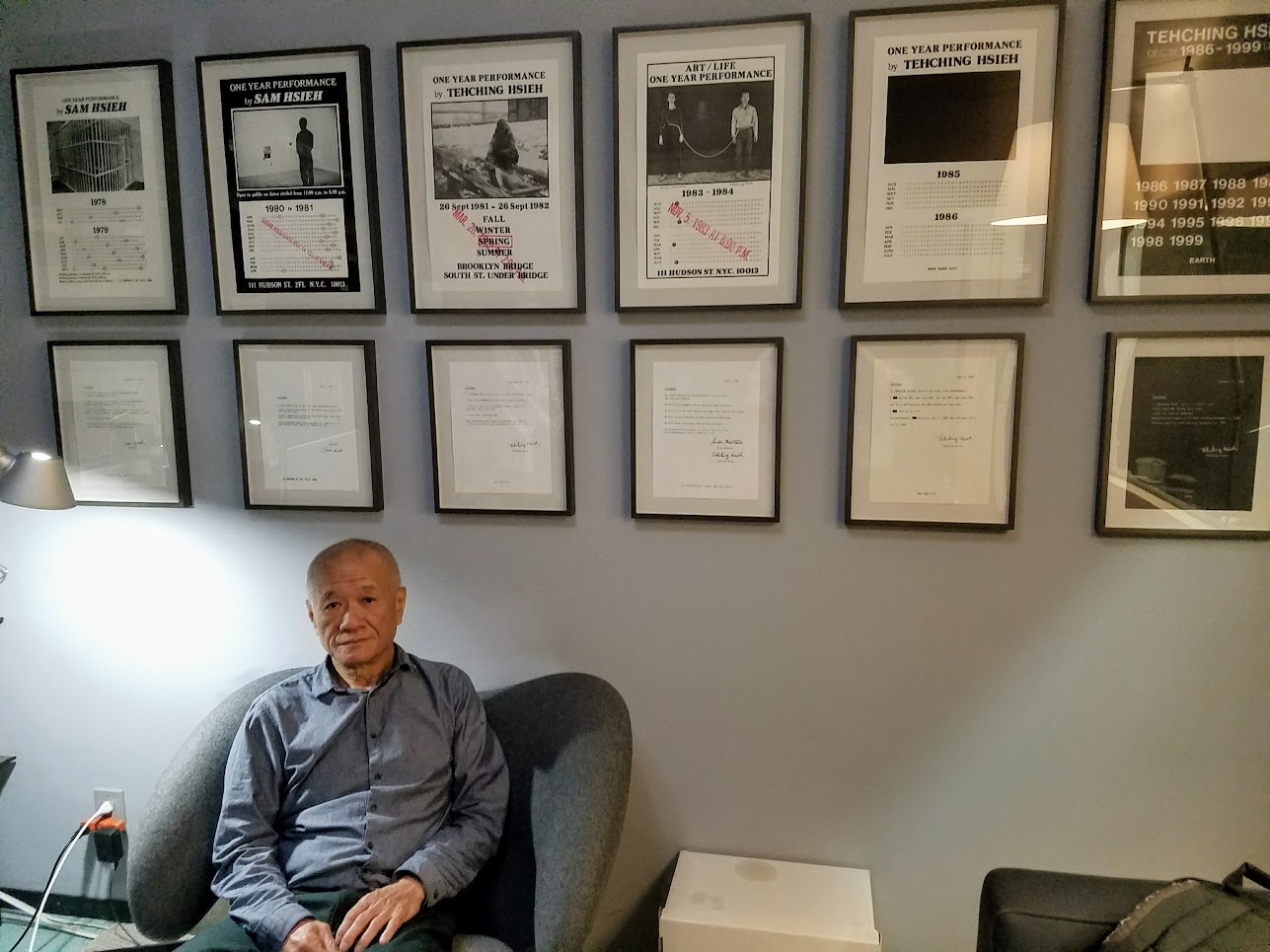
in 2018, Lisa Chen, Anelise Chen, and I had the great honor of visiting the maestro refusenik, undocumented but amnestied immigrant, godfather of performance art, and secular saint Tehching Hsieh at his Brooklyn studio. this was for The Believer, and here’s the interview that resulted. Here’s my favorite part:
Tehching Hsieh: In the beginning I couldn’t meet your kind of people. Your kind of people would say, “What is this guy, a stranger, an illegal?” Because your kind of people—this is the first time I’ve been interviewed by your kind of people in 42 years.
BLVR: Really? Wait, what do you mean, us “kind of people”?
TH: Asian American. [Laughter.] You get it! This is the first time. I’m not trying to make it an issue.
BLVR: You say this is the first time Asian Americans are interviewing you, which I find both surprising and not, but, you should know, for us, you are a very important precedent, a groundbreaker.
TH: I just wanted to say that it’s come late. Forty-two years late.
Today’s episode is a conversation with Eugene Lim, the author of the novel Search History. Eugene’s one of our favorite writers. We talk about experimental fiction, Asian writers, Eugene’s life as a school librarian, what constitutes good and bad writing, identity questions in fiction, and we even take questions from the audience who watched this talk on Discord.
“[I]t would take no more than to watch the news or check the weather to understand the scope of our ongoing losses. Lim’s goal is more ambitious: not to be a cataloguer but to ask what genre of grief could ever serve as an adequate response.” —Sohum Pal in Full Stop
“This is the sort of book that proves that the novel will never truly die, as long as there are writers like Lim venturing into new narrative territory.” —Michael J. Seidlinger in The Lineup
“The most pleasant of Search History’s many surprises is the fact that it’s really a story about grief, and is poignant and cogent in extolling this pain. The artifice of genre is everywhere, but it never stops the characters from working through their feelings.” —Nolan Kelly in Hyperallergic
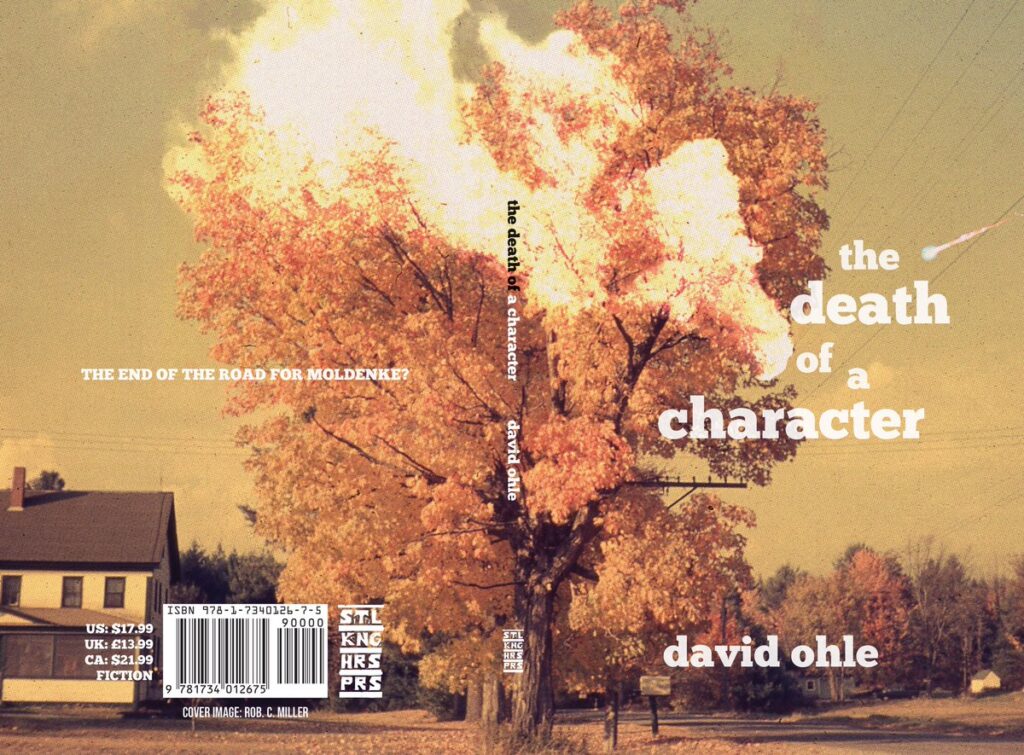
the beauty of its pacing; they wait, we wait. the spiritual and subtle use of entheogens and psilocybin. most of all an intimacy and grudging acceptance of the body, aging, sickness, and death. a current xenophobia transformed into a view of nationalities and states as various, perhaps natural, oppressions. the pop of a perfect or gross or grossly perfect or perfectly gross sentence, nonchalantly written. the hard-won insights into existence, the continuation/conclusion of a steady and sublime lifework. A great book! Thank you, David Ohle!
From October 5, 2021. I had the great privilege of launching Search History via AAWW and with the fearless and wonderful Gina Apostol.
>>”This October, we celebrated Eugene Lim‘s highly anticipated new book, Search History. With the use of brilliant prose, this uniquely inventive novel explores American culture, technology, artmaking, and storytelling through the eyes of a grieving narrator. Eugene was joined in conversation by writer Gina Apostol.”
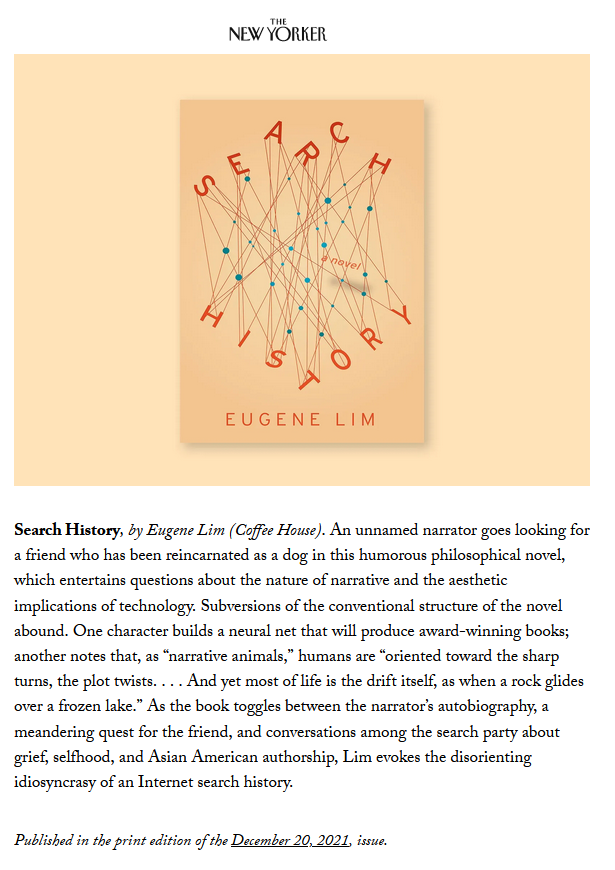
“[S]ometimes new works arrive, such as Eugene Lim’s strange, sinuous, highly memorable novel “Search History” that seem to herald some dawning technological epoch… [A] work of eerie and lasting power.”
“The construction of self and identity and the transformative nature of art underpin a work that, despite being clothed in clever satire and searing humour, is a tender exploration of how we love and what we consequently risk losing, of death and its aftermath, grief.”
From October 12, 2021. It was a hoot and a joy and a true privilege to split screens with the generous and brilliant Jonathan Lethem.
>>Eugene Lim joins us to present his new novel “Search History,” in conversation with Jonathan Lethem. This program took place on Zoom. If you’d like to purchase a copy of the book (and support Community Bookstore), you can do so here: https://www.communitybookstore.net/book/9781566896177
The Chicago Review of Books calls Search History “An Ode to Joy in Autotune,“ and says, “This novel is very funny… Search History is a living, breathing novel. Its fascinations and enthusiasms are important yet ambivalent… mature, without being self-serious or fatalistic.”
“This week’s installment of Ten Questions features Eugene Lim, whose latest novel, Search History, is out today from Coffee House Press…. Often simultaneously hilarious and devastating, Search History is an adventure story that offers profound insight into grief and grieving in the contemporary era…”
>Q: What is the earliest memory that you associate with the book? >A: I remember thinking the title would be bad for SEO.
[T]hese stories have shattered preconceived notions about novels and recast the bits into fresh forms…This bricolage surprisingly coheres by the novel’s end into an authentic expression of a mind striving to comprehend the inexplicable cruelties of the universe and humanity’s most proper response… Fans of Haruki Murakami’s melancholy, oneiric tales will also delight in Lim’s assault upon consensus reality. He encourages the reader to “stop making sense,” in the Talking Heads manner, and experience the universe as a magical tapestry of events whose overall pattern is perceivable only by God — or maybe after one’s own death.
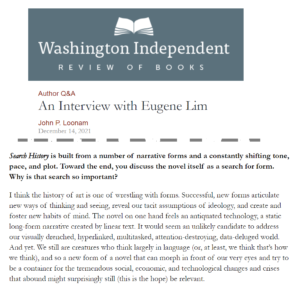
i was very happy to receive this review in the Washington Post by Paul Di Filippo. it was a very gratifying review for me as it explicitly states some of my conceptual hopes and furthermore laid them out in a personal, insightful, and elegant style. at times it felt like a duet, so seen and well represented i felt. a sincere thanks to Paul Di Filippo.
[as an aside, the review does make a small and unimportant error by misnaming one of the characters as Muriel. (it’s truly not an important detail for a reader’s experience — but why it isn’t important is kinda important. (characters are a technology that evaporate within a greater and wider sense of personhood, might be brief summary of the/my argument.) but, to the reviewer’s credit, having an unnamed narrator is always confusing (and this one might have more than one). but, to clarify: the unnamed character that goes on the global hunt with Donna Winters for the AI/dog (in my non-authoritative authorial mind) is not Muriel.]
A short story about a long story about a short story about our wedding day. A writer is invited to our wedding. She is famous for her perfected, very short stories. Later, as a gift to us, she writes a story about that day. Years later still, a composer known particularly for an aural mise-en-abyme, wherein he repeatedly records the recording of his own voice until any semblance of the original speech act “with perhaps the exception of rhythm” is destroyed, creates a similar composition based on this famous writer’s story about our wedding. I feel elated to be indirectly part of these accomplished artists’ works, but also I am fearful and am struck by profound wonder that these are based upon — and in the case of the composition also replicate — the erosion of one of my happiest memories. Selah.
A little late posting this, but here’s an interview I did a month ago as part of Entropy’s excellent small press series.
Tell us a bit about Ellipsis Press. What are your influences, your aesthetic, your mission? From our submission statement, we say: “We like novels that look normal but aren’t (more than those that look weird but are actually quite normal)…” And I think that that gets close to it. The novel is a flexible container. I think I’m interested in those books that transform and transcend the genre but in a way that brings the reader along—does not forget or insult the reader—and, in the best case, expands what it is possible to understand via new forms of long narrative.
yesterday’s writing session was a low point producing a terrible poem slash yeats pun called The 2.0 Coming. first line: “The falcon says fuck you and flies off.”
SPACE DETECTIVE HAS HER FEET ON THE DESK of her basement office. She is profoundly bored. A series of disasters has conspired to confine her to her house for several months.
She had thought she was too old for it but several of her friends have already done it. The thick fog of boredom, which she momentarily and perfunctorily acknowledges as an aspect of entitlement, finally convinces her to go. She activates the cryogen casket. She takes the pill. She puts on the suit and helmet. She double checks the IV lines and lays down in the casket. She hums the passcode and is instantly sent to Videogame.
i’ve been meaning to post about these books for a few months — but they’ve been weird and busy months. but just before the quarantine, i received an email from yongsoo park — an author i have admired but never met. he’d written two memoirs, had self-published the first and was about to self-publish the second.
i’d loved and was truly inspired by his earlier novel, BOY GENIUS published by Akashic in 2002. (i remember stumbling upon it probably at one of those pre-AWP small press book fairs they had i believe in what was the old mercantile library. i forget the name of the organization that ran these book fairs and wonder what happened to it. was it run by CLMP? this was before Center for Fiction was there. or was it a different subscription library?) … i can’t remember exactly how i found it, but BOY GENIUS was a revelation. it was asian-american literature far beyond anything i’d read before, importantly different from the (also important) foundational assimilation theme that predominated, and came from a familiar but surreal perspective. i’ve written briefly before about what it meant to me, but its very existence was crucial for me. it inspired me to keep writing, frankly, and to think there were other perspectives (somewhat like mine, near mine) that were possible in a literary world that seemed at the time beyond entrance.
the two new memoirs are very nyc books. one is about his raising his kids in harlem. and the other is about his childhood in the neighborhood where i now live: the area in queens made up of Jackson Heights and Elmhurst.
his queens is no longer there but it was here just a moment ago. he took me to where his dad’s shoe repair store used to be located, in a small stall in the Jackson Heights subway station that i used to pass every day and is now occupied by a barber shop and a cell phone accessory store. i think i moved here just as the old neighborhood was evaporating; in fact no doubt my gentrifying move was part of the titrating force that changed the formula of its place.
i love both these books. the parenting memoir reflected conflicts i’d had (and continue to have) as a korean american father, and his urban childhood — entirely different from my midwestern one — resonated more than harmonically. here’s the overly long blurb i wrote for the more recent one:
The beautifully remembered details of a Queens boyhood circa 1980s is so colored with a particular light of Korean-American immigrant experience that the reader, who could be forgiven for thinking they are reading a folksy document of yesteryear, is so bedazzled that their mesmerized state occurs before they are even aware, and achieved perhaps so subtly that the hypnotized might even deny the trick — except for a lingering and transformative mist…
Frankly, it is difficult for me to convey how gratifying and exciting it is to see such an experience articulated in print. The current argot talks about “feeling seen,” and we are in a season of new (and winning) demands for better diversity of representation in our national media. And yet how can I speak of my wonder for the writings of Yongsoo Park — whose affable and low-key style belies not only an incredible courage but weaves a steady-tempoed music that insidiously, sentence by sentence, recapitulates a past so that one is in tears at the recovery of what one was certain was lost forever. For me, from the beginning of his career with the outrageous Boy Genius to these latest memoirs, Yongsoo Park’s books are the mirror and lens I have been seeking my whole reading life — and ones I have not yet encountered elsewhere.
i’d add that if you have any interest in korean-american literature, they are a must. these are self-published books, which i wish they weren’t. i respect his decision to do so, the fulfillment of an urgency, and its maintaining of certain control — but i wish it was a different world, one that was better prepared to recognize Yongsoo Park’s adult genius. maybe it soon will.
april 2, 2020 | this morning i remembered this short short that derek white published in sleepingfish ten years ago and that seems now autobiographical and which i reproduce here in its entirety.
the whole Sleepingfish issue (edited by derek white and gary lutz) is available as a PDF through the calamari archive here: https://www.calamaripress.com/SF/8/line.htm
big thanks to Margaret Rhee and her students for this interview! They created a podcast series with author interviews, including those with myself, Mark Doten, Katie Williams, George Abraham, and Darius Kazemi.
Machine Dreams is a podcast created by the English undergraduate seminar in the Department of English at Harvard University. In our course, we’re interested in how machines, robots, and codes are represented in, and shaped by literary texts. For example, in 1920, Czech playwright Karel Capek coined the term “robot” in his play RUR (Rossum’s Universal Robots) and transformed societal conceptions of mechanical beings. The contemporary literature we read as a class, similarly push the boundaries of the intersection of technology, machines, and literature. We had the fortunate opportunity to speak with invited authors on this topic of machines and literature, and engage in a collective conversation together. What follows is a dialogue that explores robots, technology, science fiction, intimacy, human conditions, and literary form. We are also interested in literature beyond the page, and the classroom. Our podcast interview is our gesture to a Machine Dream, and we hope you enjoy listening, and join our exploration together.”
i’ve a doubling/cleaving short piece called “Diptych” in the latest issue of the Iowa Review. many thanks to editor Evan James. it’s a beaut of an issue with pieces by Joyelle McSweeney, Stacey Levine, CA Conrad, Kate Bernheimer, Wayne Koestenbaum and many amazing others. here’s a bit from my piece:
![[VIRTUAL] In Conversation: Lisa Hsiao Chen and Anelise Chen](https://aaww.org/wp-content/uploads/2022/03/Winter-2022-Programs-for-Website-9.png)